
The Department of Clinical Neurosciences at Little France recently welcomed a news crew from CNN International to highlight a world‑leading partnership between the neurosurgery team and researchers at the University of Edinburgh.
Spearheaded by neurosurgeon Paul Brennan and Race Against Dementia Fellow Dr Claire Durrant, the programme involves keeping living human brain tissue – removed during routine neurosurgery – alive for study in the laboratory.
This pioneering research has enabled scientists to show, for the first time, how a toxic form of a protein linked to Alzheimer’s can attach to and damage the connections between brain cells. The team hopes the discovery will help identify medications with the greatest potential to prevent the loss of synapses—the vital connections that allow messages to flow between brain cells and support healthy brain function.
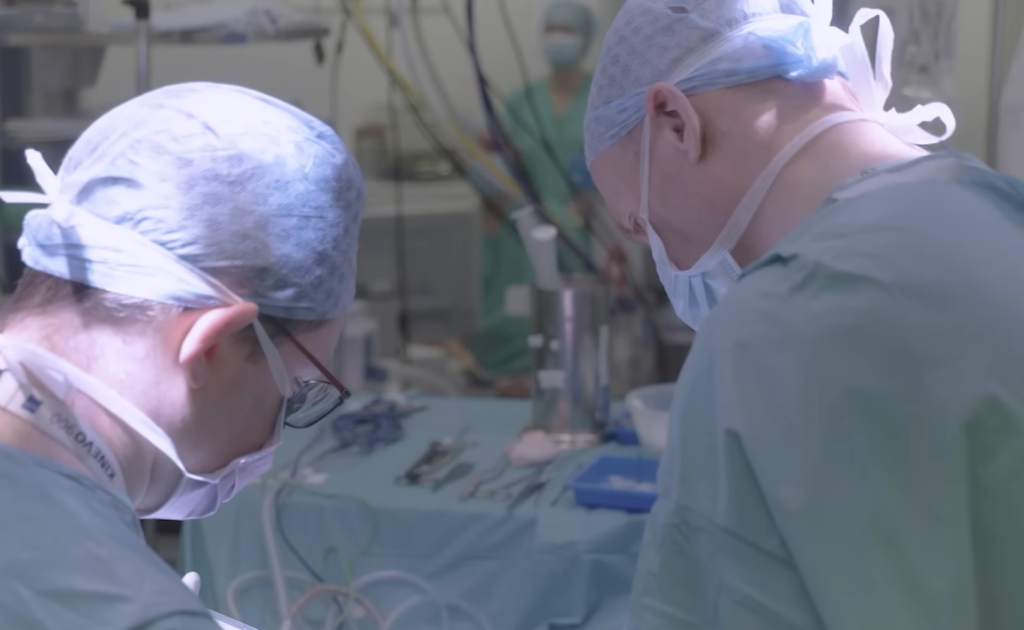
Paul Brennan said: “During neurosurgery, there is always a small amount of healthy brain tissue that must be removed in order to reach, for example, a tumour and typically that tissue would be thrown away. Our partnership with Claire and her team means we can package up that healthy, living tissue and send it to the lab for testing. Even the tiniest piece contains thousands of cells, and we can learn a great deal from it. Research of this type has been underway for some time, but this collaboration allows us to study living human brain tissue in a way that hasn’t routinely been possible before.”
The tissue is collected with the patient’s consent, in a process similar to organ donation. Aidan McAllister (28) chose to donate his healthy brain tissue during an operation to remove a tumour. He said: “My grandad passed away from Alzheimer’s a few years ago. We were really close – he lived just across the road and we saw each other every day. His dementia became so severe that he didn’t know who he was or who we were. It’s a really brutal disease. When Paul asked if I’d consider donating some of my brain tissue during surgery, I thought if it could help people like my grandad, then I wanted to do it.”
Dr Claire Durrant said: “We believe this research could accelerate the journey from lab findings to patient treatments, bringing us one step closer to a world free from the heartbreak of dementia. It was fantastic to be able to show the CNN team what we do and to highlight the vital, world-leading research taking place in Edinburgh.”